

Confluence Google Drive Integration
Create a single source of truth with seamless syncing and real-time collaboration.
Read more


Administrators can adjust how the Google Drive Connector for Confluence app works to meet your team's needs and comply with company policies.
These settings are visible only to Confluence admins. To open them, go to Confluence settings and select Google Drive Connector Settings in the sidebar.
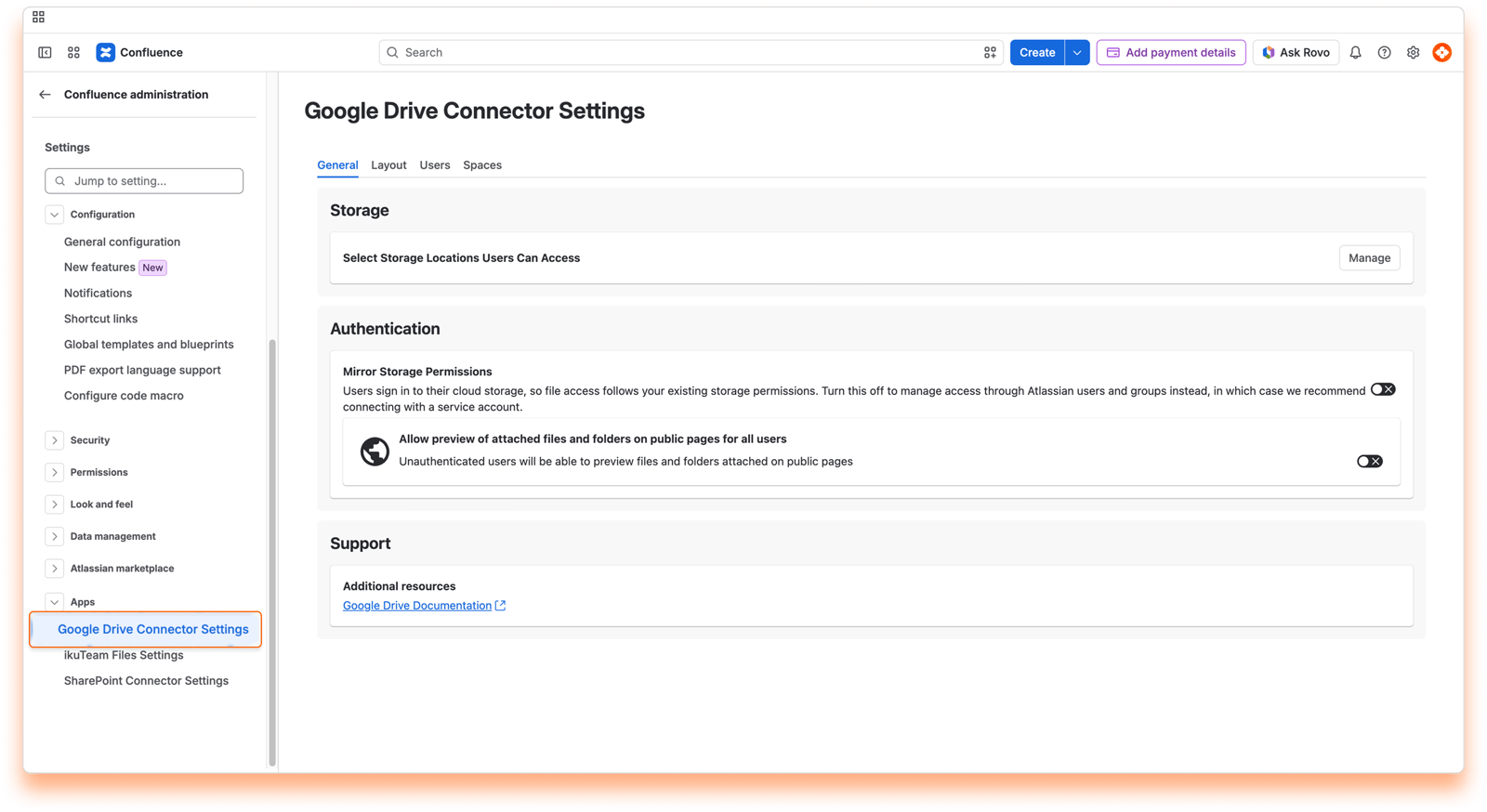
On the General tab, the Storage card has a Manage button that opens the Allowed storage places dialog. Google Drive is the only option there, and it's turned on by default. You can turn it off and on again. Keep it on: if you turn Google Drive off, users can't connect Google accounts or folders, and the folders already connected and the files and folders attached from them are blocked until you turn it back on. Changes save automatically and apply immediately.
Mirror Storage Permissions is ON by default, so each user signs in with their own Google account and the permissions set in Google Drive apply. Admins can switch to Mirror Storage Permissions OFF to use simplified permissions instead, meaning the permissions you set here are the only ones that apply. Google Drive permissions are then bypassed, so any Confluence user you grant access to can view or edit files regardless of their access in Google Drive. The files in your Google Drive remain unchanged; only how they're accessed through Google Drive Connector is affected.
One thing worth noting: in the simplified setup, the app uses the Google account of the person who connected the folder, so all activity in Google Drive is logged under that account. With Mirror Storage Permissions OFF, we recommend connecting folders with a service account instead of a personal account. That way, your audit trail stays clear and folders keep working when people leave.
With Mirror Storage Permissions ON, both layers apply at the same time, and the more restrictive one always wins:
A user without edit access in Google Drive cannot edit, even if their Google Drive Connector permission allows it.
A user with edit access in Google Drive won't see the edit button if their Google Drive Connector permission restricts it.
Think of it as a double lock: a user needs to pass both checks to perform any action. Use this Mirror Storage Permissions setting together with connected folder permissions for precise control over how files are shared, viewed, and edited.
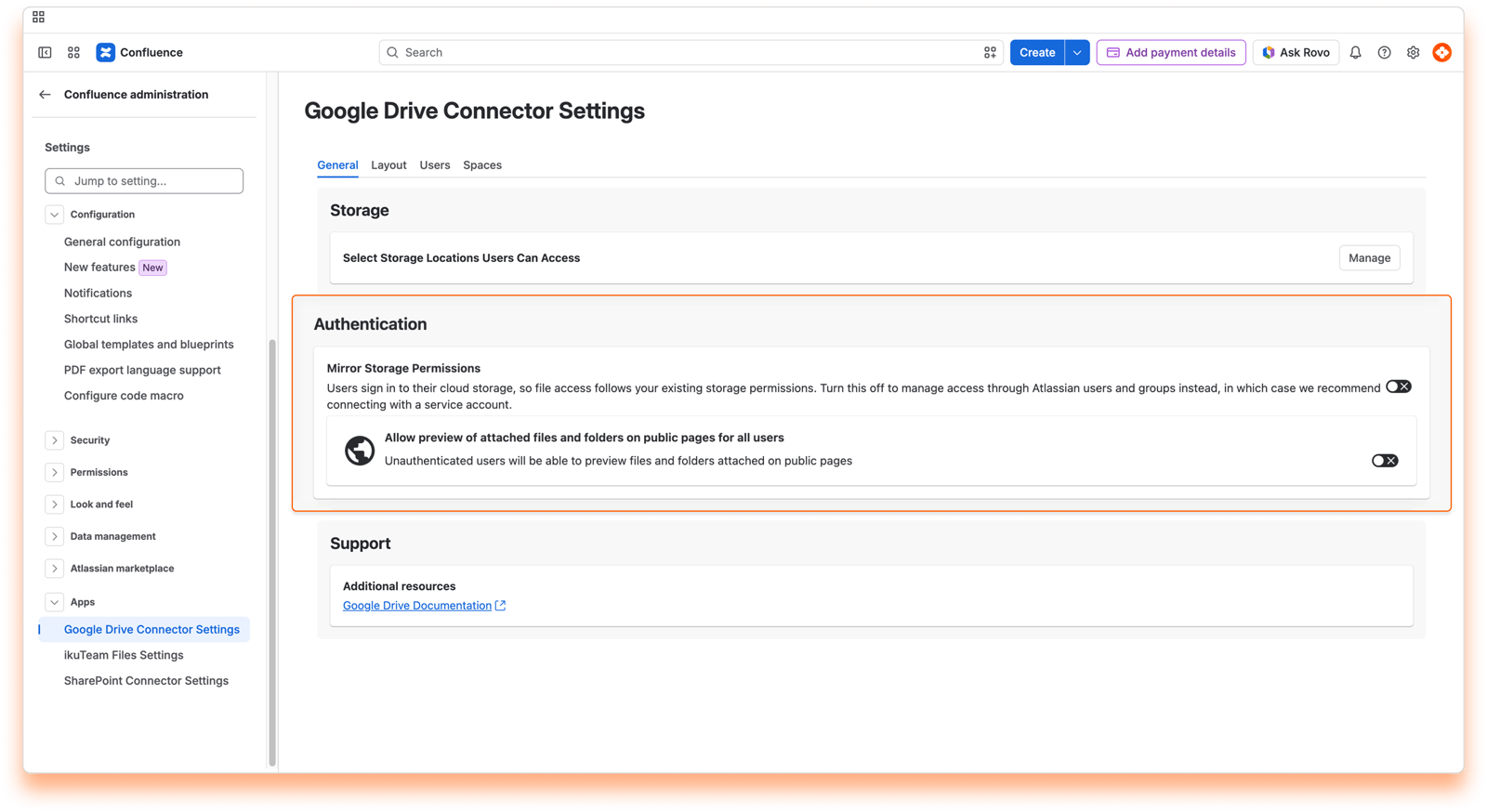
With Mirror Storage Permissions ON, each user signs in to each connected folder with their own Google account, so the right permissions apply to everyone. With Mirror Storage Permissions OFF, users don't sign in per folder, and the app uses the folder owner's account for everyone. With Mirror Storage Permissions ON, public pages are not supported. Learn what changes with Mirror Storage Permissions OFF
On the "General" tab of the Google Drive Connector Settings page, go to the Authentication card.
Click the toggle to turn off the option "Mirror Storage Permissions".
Changing this setting saves automatically and applies immediately.
On the "General" tab of the Google Drive Connector Settings page, go to the Authentication card.
Click the toggle to turn on the option "Mirror Storage Permissions".
Changing this setting saves automatically and applies immediately.
In a space open to unauthenticated users, they can preview files and folders attached with Google Drive Connector to public pages. This needs Mirror Storage Permissions OFF. The option "Allow preview of attached files and folders on public pages for all users" then appears in the Authentication card, and an admin turns it on. A confirmation dialog opens: select I understand any user can view attached content in public pages. and click Allow.
With this option active, any user can view the content of all attached files in public pages without any authentication. This can be turned off at any moment.
With Mirror Storage Permissions ON, the preview of attached files and folders on public pages is NOT supported. Mirror Storage Permissions is ON by default, so to allow public page previews, an admin first switches to Mirror Storage Permissions OFF.
Unauthenticated users can't edit the content of Google Drive Connector macros, even if the space allows them to edit pages.
By default, the files and folders attached to Confluence pages use a regular header and appear in the collapsed view to use less space on the screen. It's easy to preview the file by clicking the arrow to open the expanded view, which uses the width of the page and is 464px tall by default, or clicking the file name (or preview button) to open the full-screen preview.
The Admin can set different defaults for new macros on the "Layout" tab of the Admin settings.
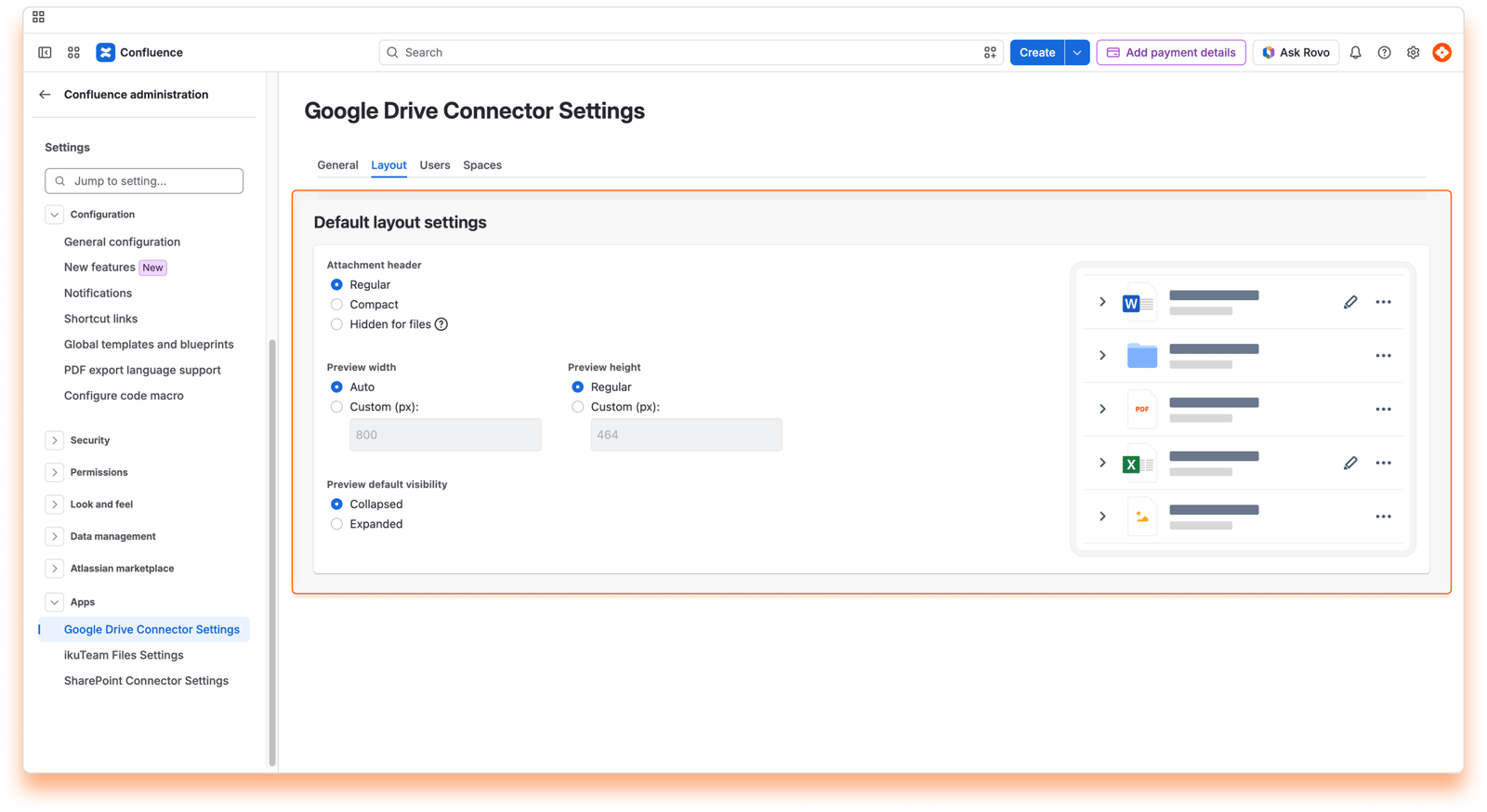
Select the default size for the header of new macros:
Regular: The standard size for the header of attached files and folders. It shows a big icon and additional details;
Compact: Uses a smaller icon and only shows the name of the file or folder;
Hidden for files: Completely hides the file header and forces the expanded preview option. Moving the mouse over the file will show a compact header.
Select the default width for the preview:
Auto: The standard width for previews uses the available space;
Custom: Define a value for the width of the preview area.
Select the default height for the preview:
Regular: The standard height for previews (464px);
Custom: Define a value for the height of the preview area.
Select the default behavior for the preview:
Collapsed: The standard option that hides the preview;
Expanded: Automatically shows the preview of files and folders. This option is required when selecting the "Hidden for files" header.
Changes to these settings are saved automatically and applied immediately.
All users and groups can use the Google Drive Connector for Confluence app by default. It's accessible through a link on the space sidebar and as a macro on pages to attach files and folders.
However, an Admin can specify which users and groups can use the Google Drive Connector for Confluence app. When someone is not permitted to use the app, the file manager and the macro are blocked.
The current settings are on the "Users" tab. There are three main options that you can select from the drop-down menu:
All users and groups can access the Google Drive Connector for Confluence app with the default option.
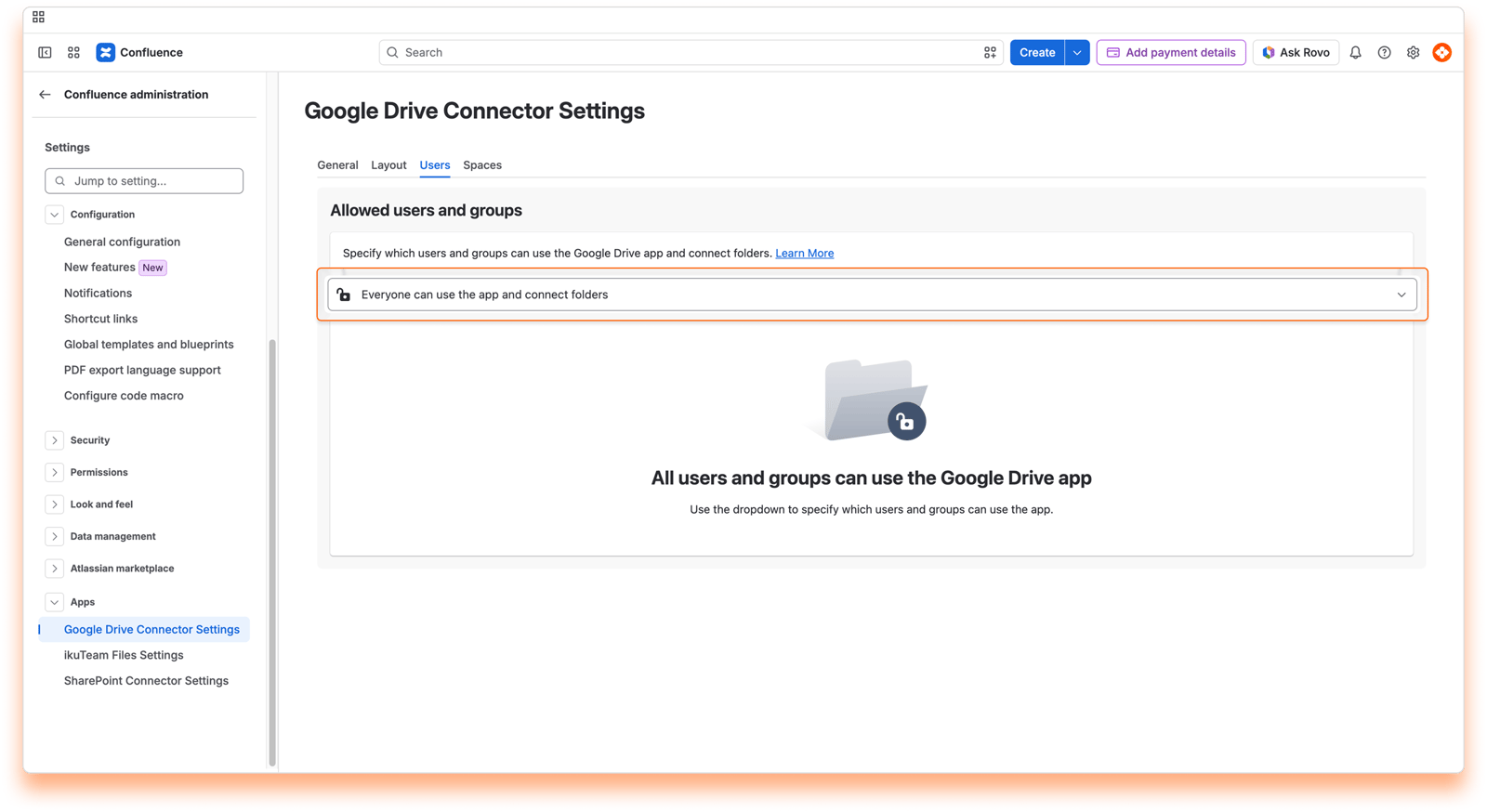
Select this option if everyone should be able to use the Google Drive Connector for Confluence app, but only some users and groups can connect folders.
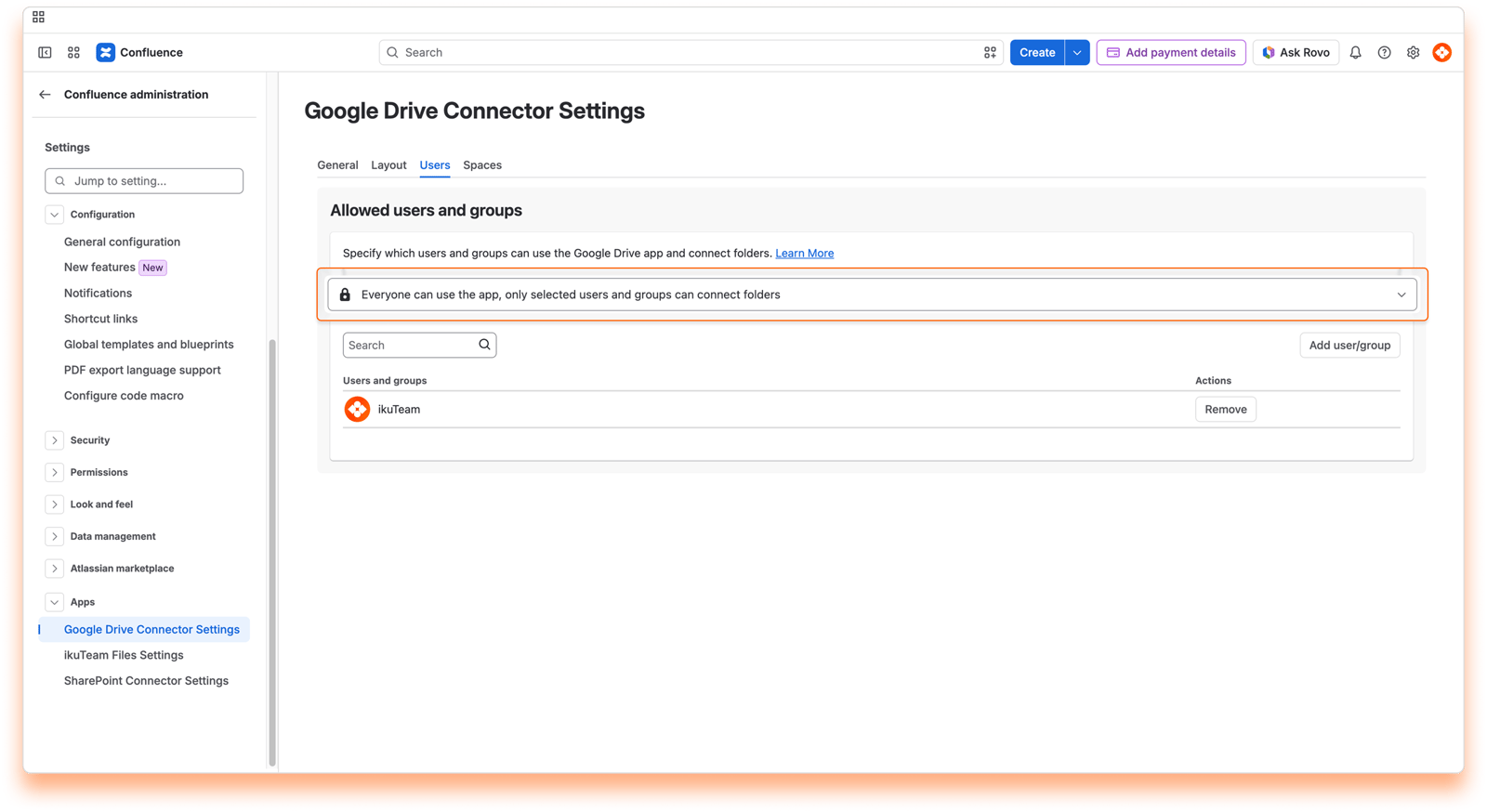
Click the "Add user/group" button, start typing to select a name, and click the "Add" button. The user or group gets access to connect folders immediately.
Search for the user or group you want to remove, click the "Remove" button, and confirm. The option to connect folders will be hidden from the user or group immediately.
Select this option if you want only some users and groups to use the Google Drive Connector for Confluence app and specify who can connect folders.
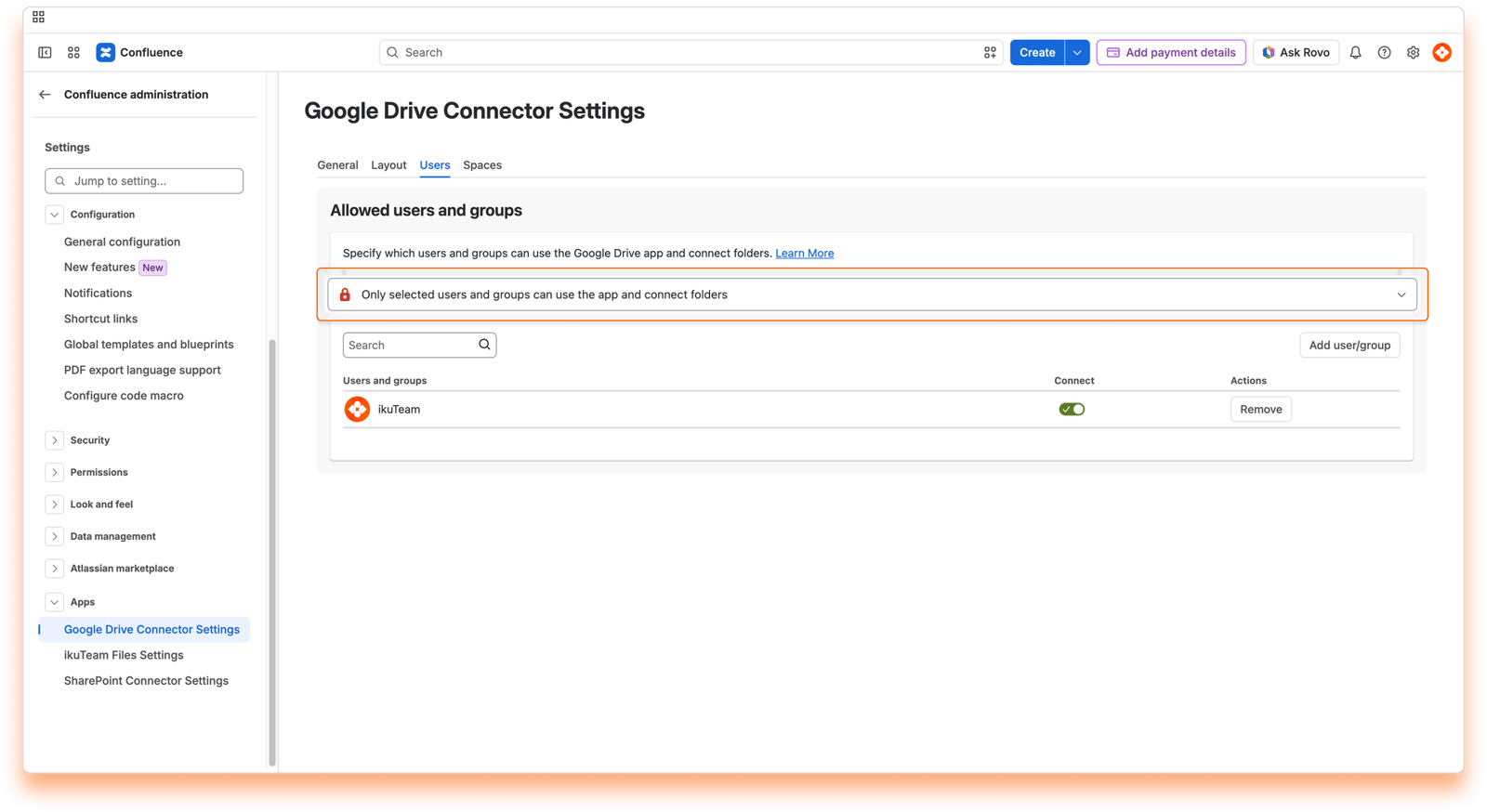
Click the "Add user/group" button, start typing to select a name, and click the "Add" button. The user or group will have immediate access to the app.
Use the toggle button to determine if a user or group can connect folders.
Search for the user or group you want to remove, click the "Remove" button, and confirm. The app will be blocked for that user or group immediately.
By default, all spaces can use the Google Drive Connector for Confluence app. It's accessible with a link on the space sidebar and as a macro on pages to attach files and folders.
However, an Admin can specify which Confluence spaces can use the Google Drive Connector for Confluence app. Blocking a space from using the app hides the file manager and turns off the macro for that space.
On the "Spaces" tab, you can see the current settings. There are three main options that you can select from the drop-down menu:
This is the default option, meaning every space can access the Google Drive Connector for Confluence app.
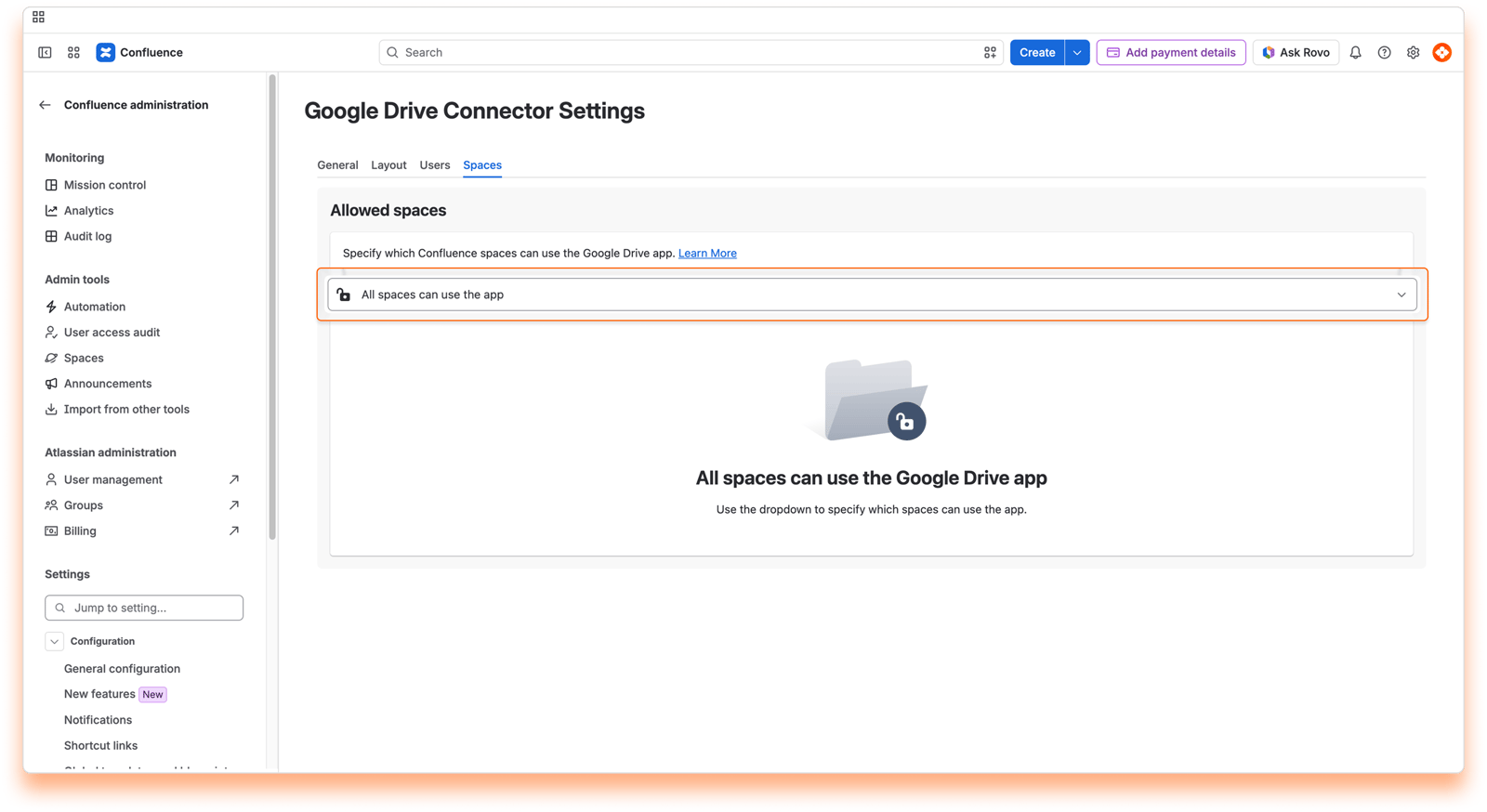
Select this option if you only want to allow the Google Drive Connector for Confluence app for some spaces.
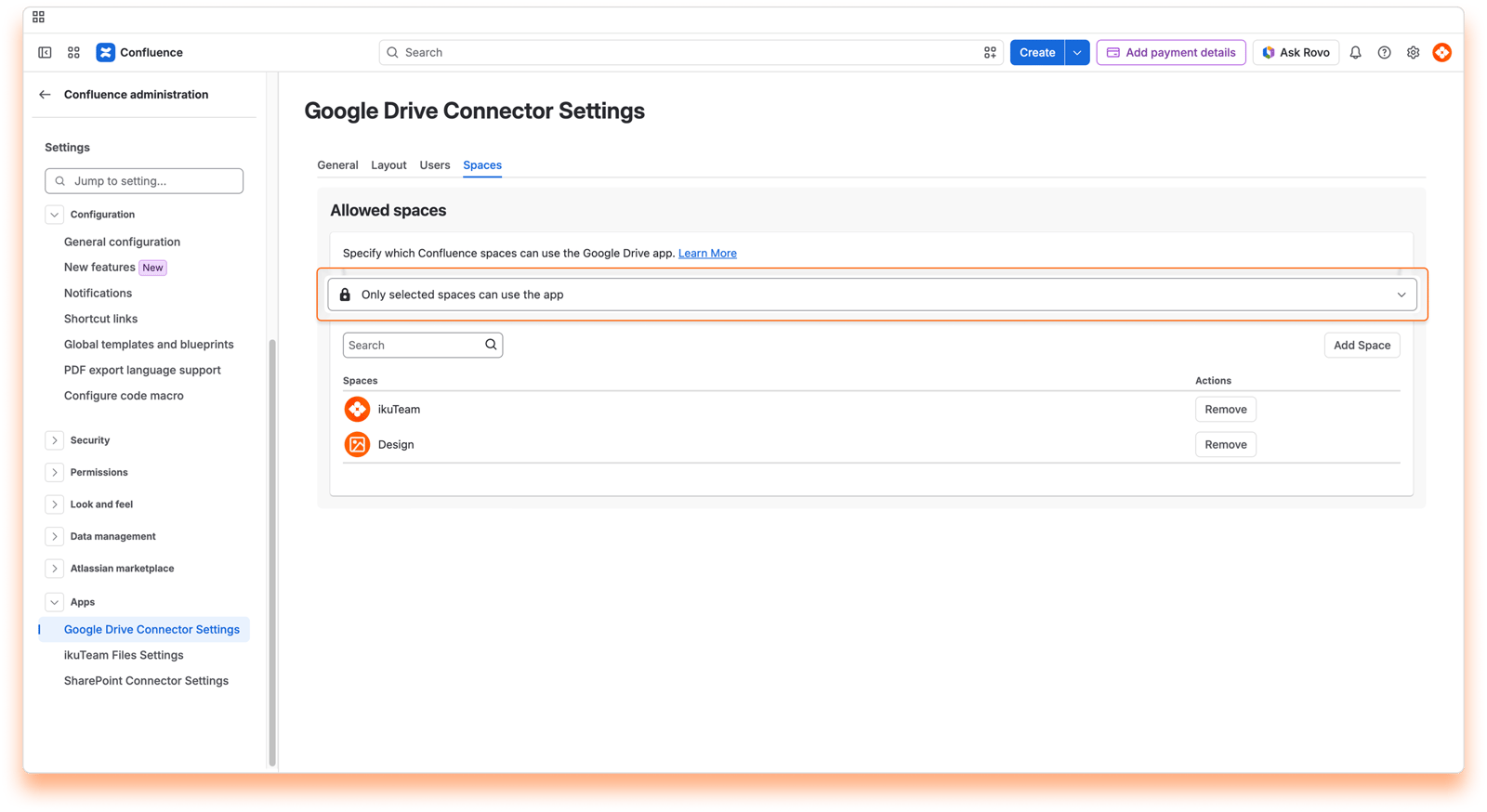
Click the "Add Space" button, start typing to select a space, and click the "Add" button. The space will have immediate access to the app.
When searching for a specific space, please keep in mind that the Atlassian CQL search has limitations for texts that include any of these special characters: + - && || ! ( ) { } [ ] ^ " ~ * ? : \ /
If your space name includes one of these characters, you can search for the space key instead.
Search for the space you want to remove, click the "Remove" button, and confirm. The app will be hidden from that space immediately.
Select this option if you only want to hide the Google Drive Connector for Confluence app for some spaces.
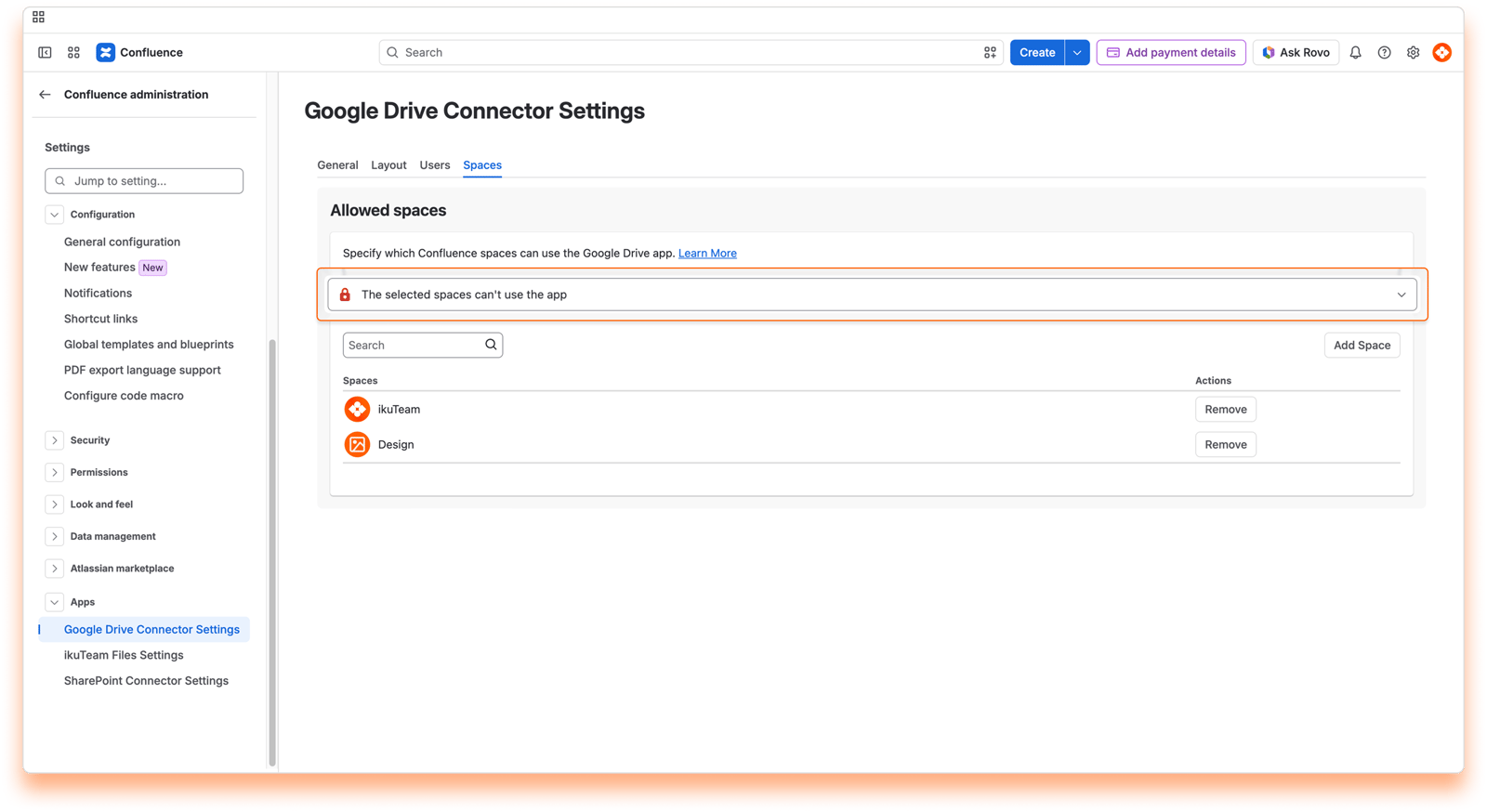
Click the "Add Space" button, start typing to select a space, and click the "Add" button. The app is hidden from the space immediately.
Search for the space you want to remove, click the "Remove" button, and confirm. The space will immediately have access to the app.
Blocking the Google Drive Connector for Confluence app on a space using it hides the file manager link and all the files and folders attached to pages. The attachments reappear if the app is allowed again.
Space admins can also turn the Google Drive Connector app on or off in the Space Settings, as long as the Admin allows.
On this page, you learned about all the Admin settings available.
If you still have questions about the topics covered on this page, visit our support portal and send them to us. Our team is always happy to help.


