From the start, our goal has been to remove the hidden friction that prevents teammates from collaborating easily on the files that matter most. We believe productivity is not about adding more tools but making the ones you already use work together seamlessly. Based in Porto, ikuTeam builds the invisible layer for the Atlassian ecosystem to dissolve file silos and help over a million users stay focused and move faster.
From the start, our goal has been to remove the hidden friction that prevents teammates from collaborating easily on the files that matter most. We believe productivity is not about adding more tools but making the ones you already use work together seamlessly. Based in Porto, ikuTeam builds the invisible layer for the Atlassian ecosystem to dissolve file silos and help over a million users stay focused and move faster.
Take the first steps to use ikuTeam Files for Confluence.
Open ikuTeam Files for Confluence
You can install ikuTeam Files for Confluence from the Atlassian Marketplace, then open it from Space apps in your space sidebar. It's ready to use.
Connect your first folder
You don't need to create an account to use the app. The only thing required is to connect at least one folder to the Confluence Space so that you can start collaborating with your team and build your single source of truth.
If a folder is connected when you first open the app, someone in your team has already shared a folder. You can use that one or add more by following the same steps.
A. Add a folder from the file manager
Add a folder to your space from the ikuTeam Files file manager.
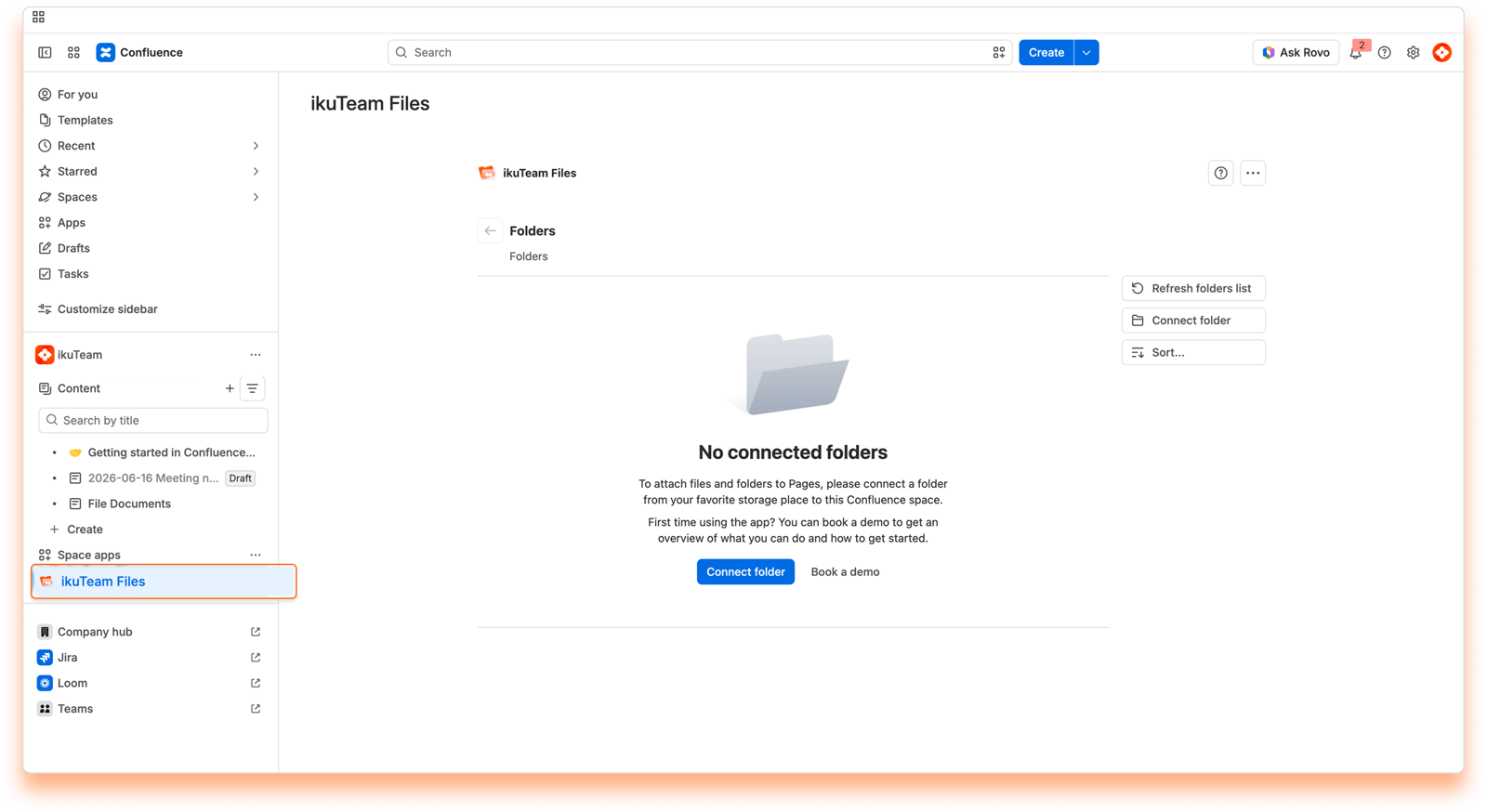
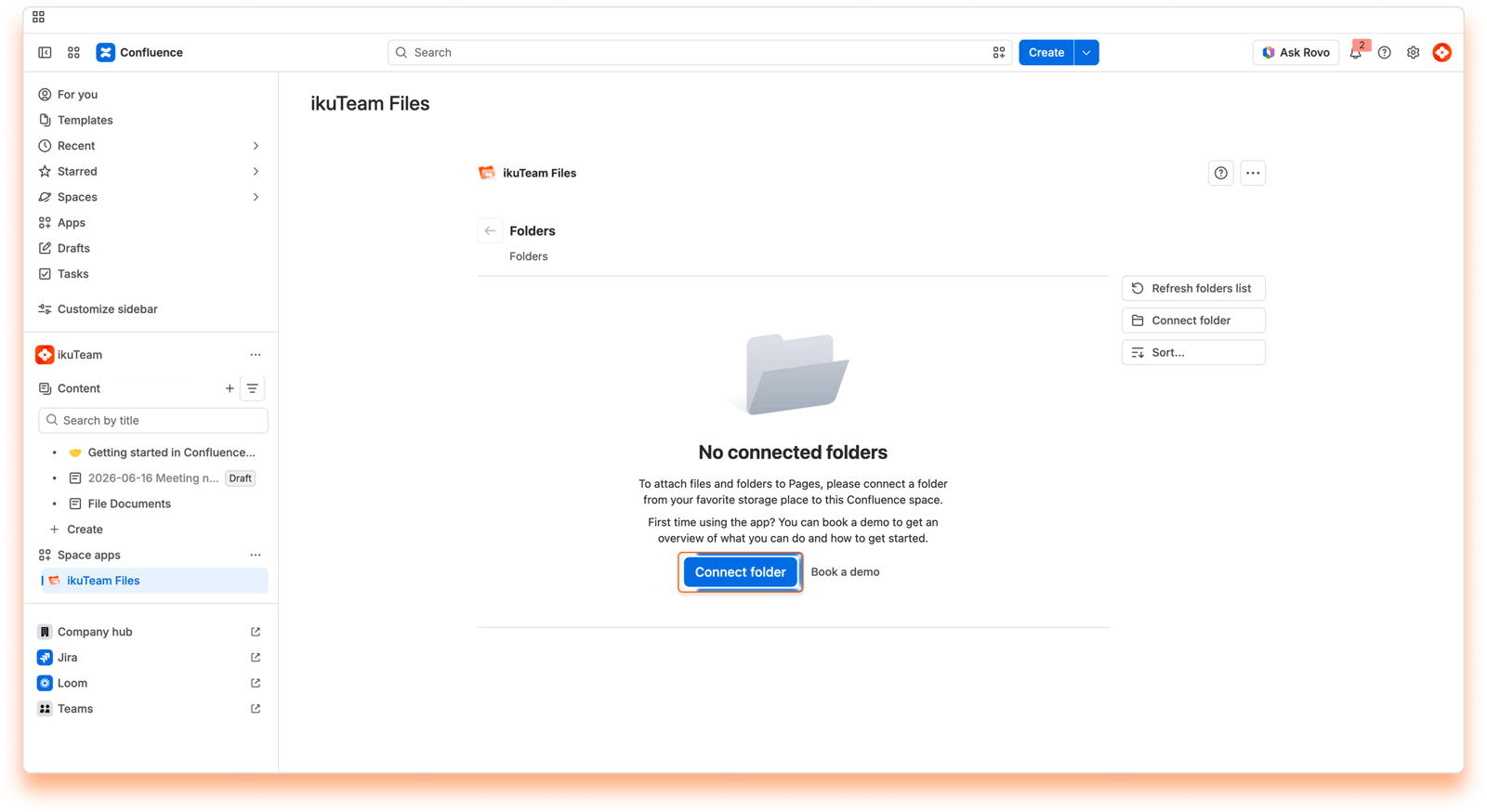
Step 1: Click the "Connect folder" button
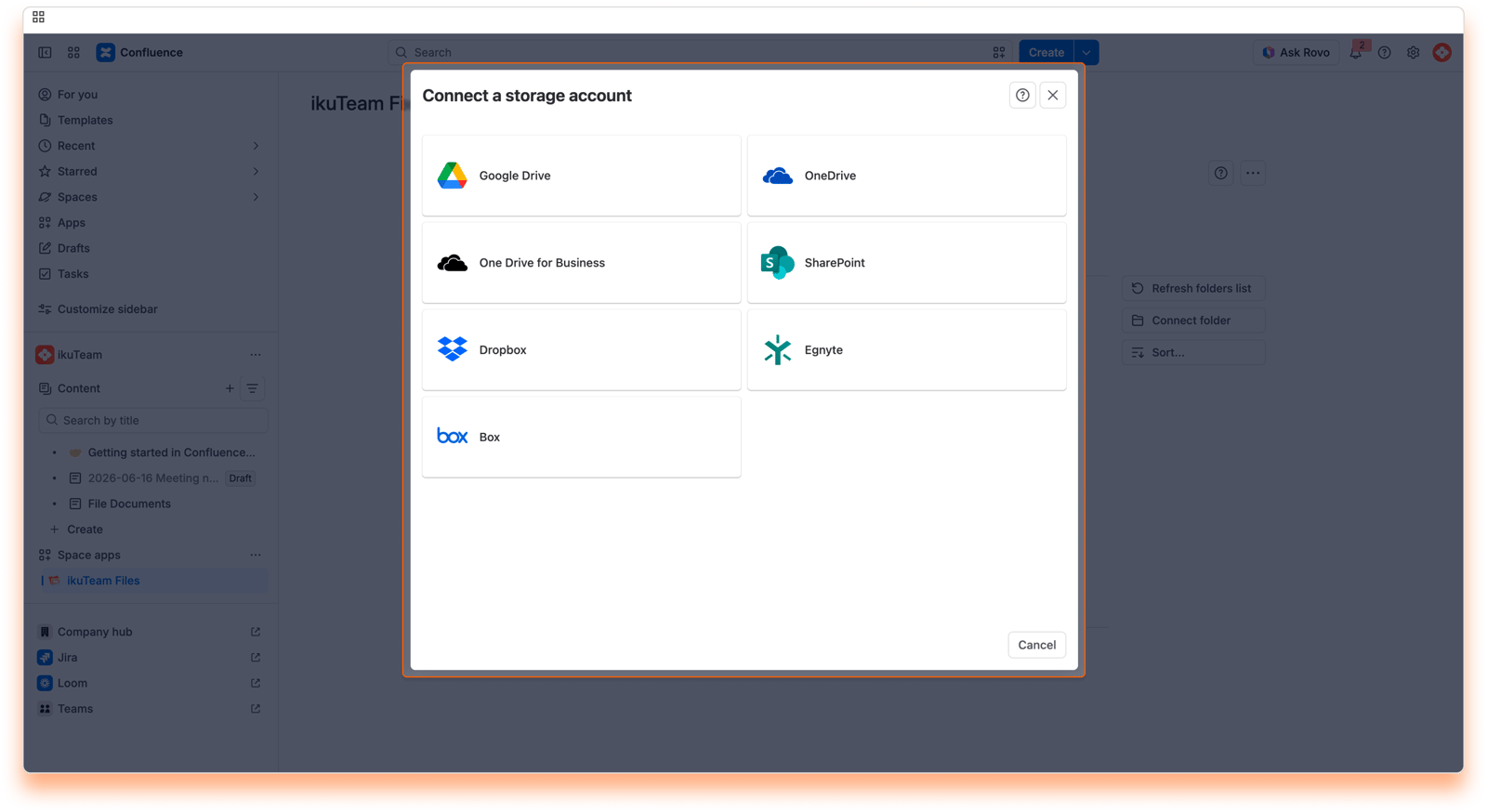
Step 2: Select the storage place where the folder you want to connect is and authenticate
You can connect a folder stored in SharePoint, OneDrive for Business, Google Drive, Dropbox, OneDrive, Box, or Egnyte.
Make sure your browser allows pop-ups. A new tab opens to let you authorize the remote storage for your Confluence site.
You can connect more places later from the file manager. Learn more
Connecting a Dropbox folder
Connecting a Dropbox folder
Learn how to authorize the ikuTeam Files for Confluence app to access the content in your Dropbox account so that you can connect a folder.
Instructions
In the file manager, click the "Connect folder" button on the right (or select the option from the [···] menu if the window is too narrow).
If it's your first time connecting to a storage place, skip this step. The modal dialog shows a list with your connected storages. Click the "Connect account" button.
Select Dropbox from the list.
If you're not signed in to your Dropbox, sign in when the screen loads.
Press the "Allow" button, or select the account you want to authorize if you have a business account.
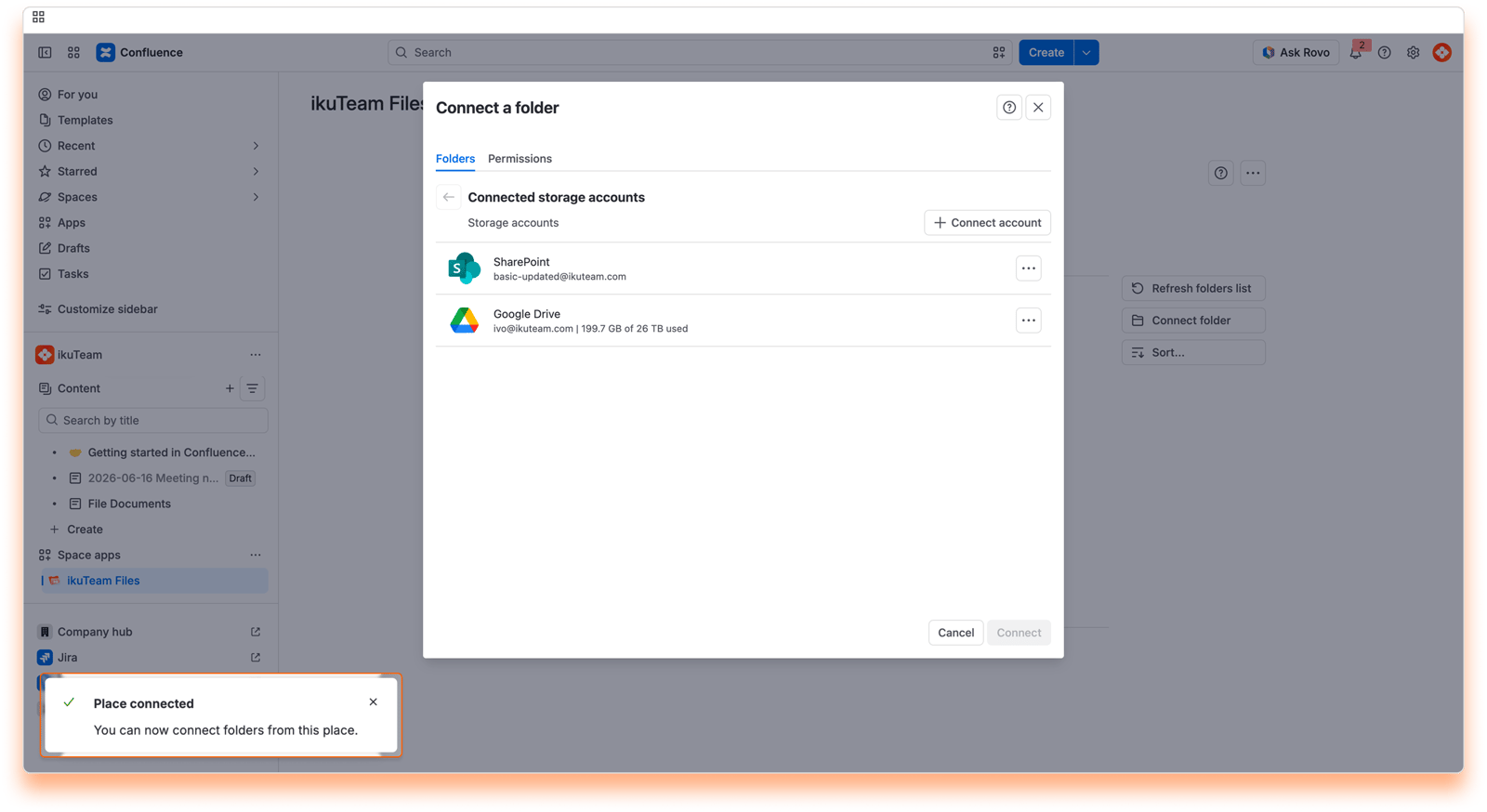
You can now browse your Dropbox to connect a folder to your Confluence space.
We never store your username or password. We use state-of-the-art OAuth 2.0 to connect securely through an encrypted connection. The app gets an authorization token to use the storage. You can revoke this authorization at any time.
Connecting a Google Drive folder
Connecting a Google Drive folder
Learn how to authorize the ikuTeam Files for Confluence app to access the content in your Google Drive account so that you can connect a folder.
Instructions
In the file manager, click the "Connect folder" button on the right (or select the option from the [···] menu if the window is too narrow).
If it's your first time connecting to a storage place, skip this step. The modal dialog shows a list with your connected storages. Click the "Connect account" button.
Select Google Drive from the list.
If you're not signed in to your Google Drive, sign in when the screen loads.
Press the "Allow" button.
You can now browse your Google Drive to connect a folder to your Confluence space.
We never store your username or password. We use state-of-the-art OAuth 2.0 to connect securely through an encrypted connection. The app gets an authorization token to use the storage. You can revoke this authorization at any time.
Connecting a SharePoint folder
Connecting a SharePoint folder
Learn how to authorize the ikuTeam Files for Confluence app to access the content in your SharePoint account so that you can connect a folder.
Instructions
In the file manager, click the "Connect folder" button on the right (or select the option from the [···] menu if the window is too narrow).
If it's your first time connecting to a storage place, skip this step. The modal dialog shows a list with your connected storages. Click the "Connect account" button.
Select SharePoint from the list.
Sign in when the screen loads.
Press the "Allow" button.
You can now browse your SharePoint to connect a folder to your Confluence space.
We never store your username or password. We use state-of-the-art OAuth 2.0 to connect securely through an encrypted connection. The app gets an authorization token to use the storage. You can revoke this authorization at any time.
Learn how to authorize the ikuTeam Files for Confluence app to access the content in your OneDrive for Business account so that you can connect a folder.
Instructions
In the file manager, click the "Connect folder" button on the right (or select the option from the [···] menu if the window is too narrow).
If it's your first time connecting to a storage place, skip this step. The modal dialog shows a list with your connected storages. Click the "Connect account" button.
Select OneDrive for Business from the list.
Sign in when the screen loads.
Press the "Allow" button.
You can now browse your OneDrive for Business to connect a folder to your Confluence space.
We never store your username or password. We use state-of-the-art OAuth 2.0 to connect securely through an encrypted connection. The app gets an authorization token to use the storage. You can revoke this authorization at any time.
Learn how to authorize the ikuTeam Files for Confluence app to access the content in your OneDrive account so that you can connect a folder.
Instructions
In the file manager, click the "Connect folder" button on the right (or select the option from the [···] menu if the window is too narrow).
If it's your first time connecting to a storage place, skip this step. The modal dialog shows a list with your connected storages. Click the "Connect account" button.
Select OneDrive from the list.
Sign in when the screen loads.
Press the "Allow" button.
You can now browse your OneDrive to connect a folder to your Confluence space.
We never store your username or password. We use state-of-the-art OAuth 2.0 to connect securely through an encrypted connection. The app gets an authorization token to use the storage. You can revoke this authorization at any time.
Connecting a Box folder
Connecting a Box folder
Learn how to authorize the ikuTeam Files for Confluence app to access the content in your Box account so that you can connect a folder.
Instructions
In the file manager, click the "Connect folder" button on the right (or select the option from the [···] menu if the window is too narrow).
If it's your first time connecting to a storage place, skip this step. The modal dialog shows a list with your connected storages. Click the "Connect account" button.
Select Box from the list.
Sign in when the screen loads.
Press the "Allow" button.
You can now browse your Box to connect a folder to your Confluence space.
We never store your username or password. We use state-of-the-art OAuth 2.0 to connect securely through an encrypted connection. The app gets an authorization token to use the storage. You can revoke this authorization at any time.
Connecting an Egnyte folder
Connecting an Egnyte folder
Learn how to authorize the ikuTeam Files for Confluence app to access the content in your Egnyte account so that you can connect a folder.
Instructions
In the file manager, click the "Connect folder" button on the right (or select the option from the [···] menu if the window is too narrow).
If it's your first time connecting to a storage place, skip this step. The modal dialog shows a list with your connected storages. Click the "Connect account" button.
Select Egnyte from the list.
Enter your company domain for Egnyte.
Enter your email or username and password to Sign in.
Press the "Allow Access" button.
You can now browse your Egnyte to connect a folder to your Confluence space.
We never store your username or password. We use state-of-the-art OAuth 2.0 to connect securely through an encrypted connection. The app gets an authorization token to use the storage. You can revoke this authorization at any time.
Step 3: Navigate to where the folder you want to share with your team is
Once the connection is successful the previous tab will give you a success message and the site will be added to the list.
SharePoint tip: If you can’t see the site where your folder is, use “Find site” to enter the site address, or “Connect by URL” to paste the folder's share link.
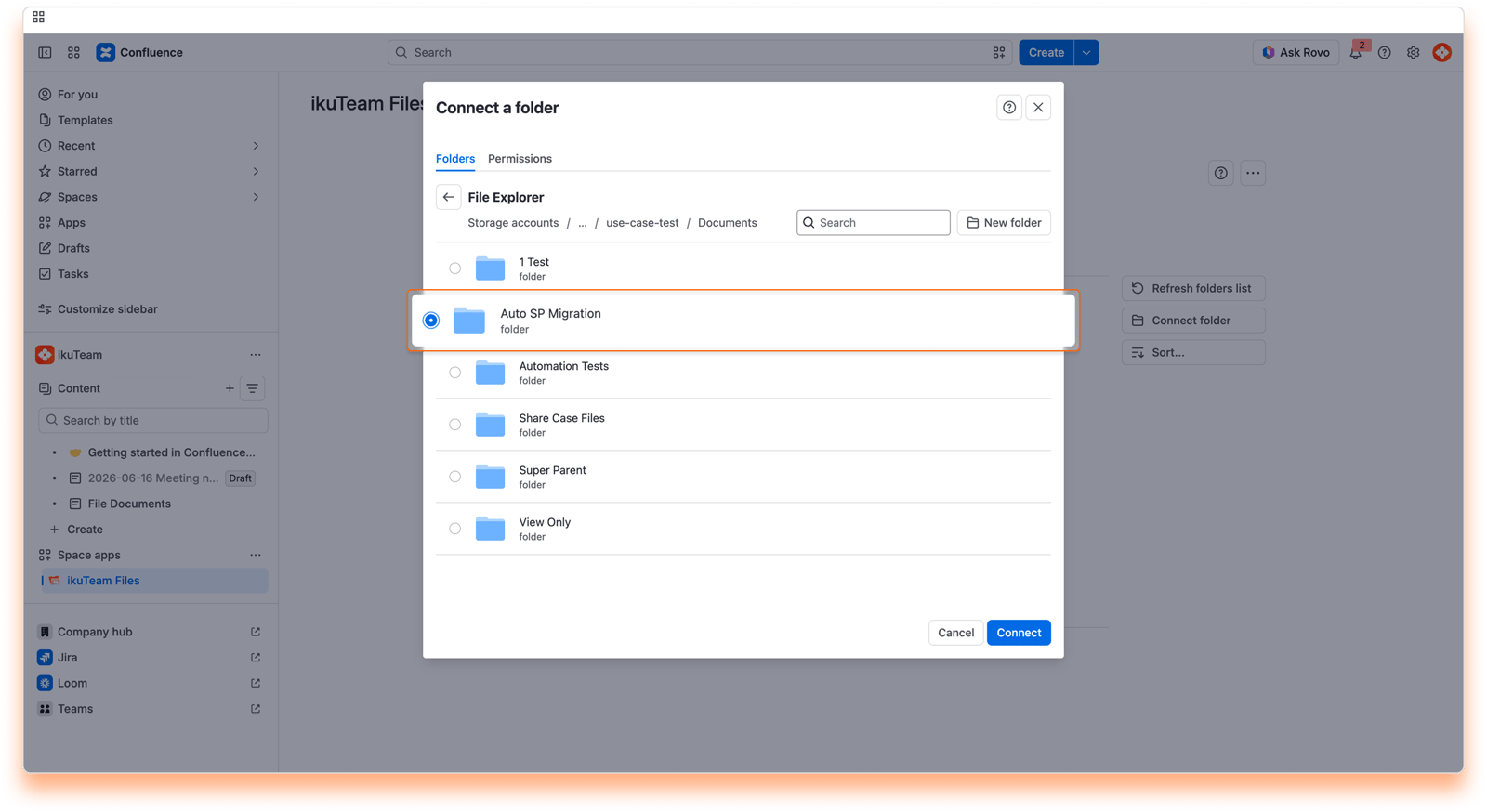
Step 4: Select the folder you want to connect
Use the checkbox to select the folder you want to connect.
We recommend connecting a folder where you and your team store your documents, but you can start with a new one by clicking the "New folder" button.
Tip: You can select multiple folders.
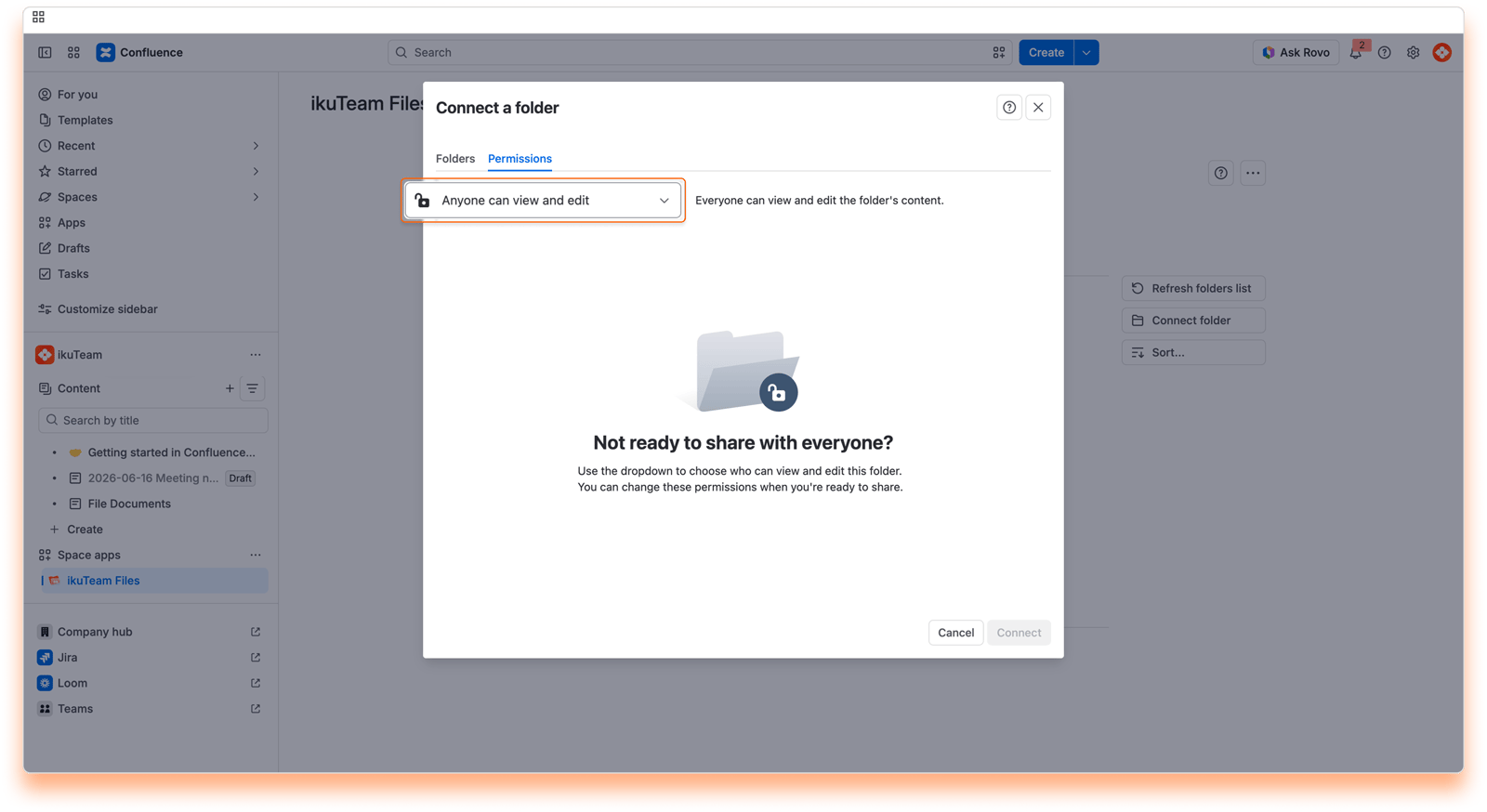
Step 5: Select permissions (optional)
Click the "Permissions" tab. By default, your team can view and edit any folders you connect. If you want to limit access or block the edit feature, click the dropdown to change the permissions.
Your cloud storage is the single source of truth. A few things to know:
When you share the same file on several Confluence pages, an edit made in one place shows up in all of them.
If someone deletes a file or folder from the connected storage (for example OneDrive, Google Drive or Dropbox), it's no longer available on the Confluence pages it's attached to.
If someone edits an attached file in the cloud storage, for example with a desktop app, you see the changes in Confluence too.
This way you avoid duplicates and untracked versions across tools: one file, the same everywhere. Just handle it with care.
CookieYes Debug: Script loaded but banner not showing. Check console for errors.