

Confluence Google Drive Integration
Create a single source of truth with seamless syncing and real-time collaboration.
Read more


The ikuTeam Files Agent for Confluence is a specialized AI extension designed to work alongside Atlassian Rovo. It bridges the gap between your Atlassian workspace and your external cloud storage, including SharePoint, Google Drive, OneDrive, Box, Dropbox, and Egnyte.
Instead of opening and reading every attached or linked file yourself, just ask Rovo. When you ask, the agent pulls the file from your cloud storage, extracts its text and hands it to Rovo. The app is built on Atlassian’s Forge platform, and we never store your files’ content.
To set up Atlassian Rovo in Confluence, you must be an Organization Admin.
Your site must have:
Atlassian Rovo active on your site (Rovo is available on Standard, Premium, and Enterprise plans). More details about Rovo plans and trials here: Rovo Plans and Trial | Atlassian. Admins can confirm the current state with the Rovo activation guide and manage who can use Rovo in Manage Rovo access.
ikuTeam Files for Confluence installed with the Advanced Edition, with at least one folder connected to the space in the file manager.
Once these are in place, everyone in the space can use the agent without any setup of their own.
Enable Atlassian Rovo: Follow Atlassian's Rovo activation guide to enable the feature on your site.
Locate Rovo Chat: Once enabled, you will see the Ask Rovo button next to the notification icon in your Confluence site.
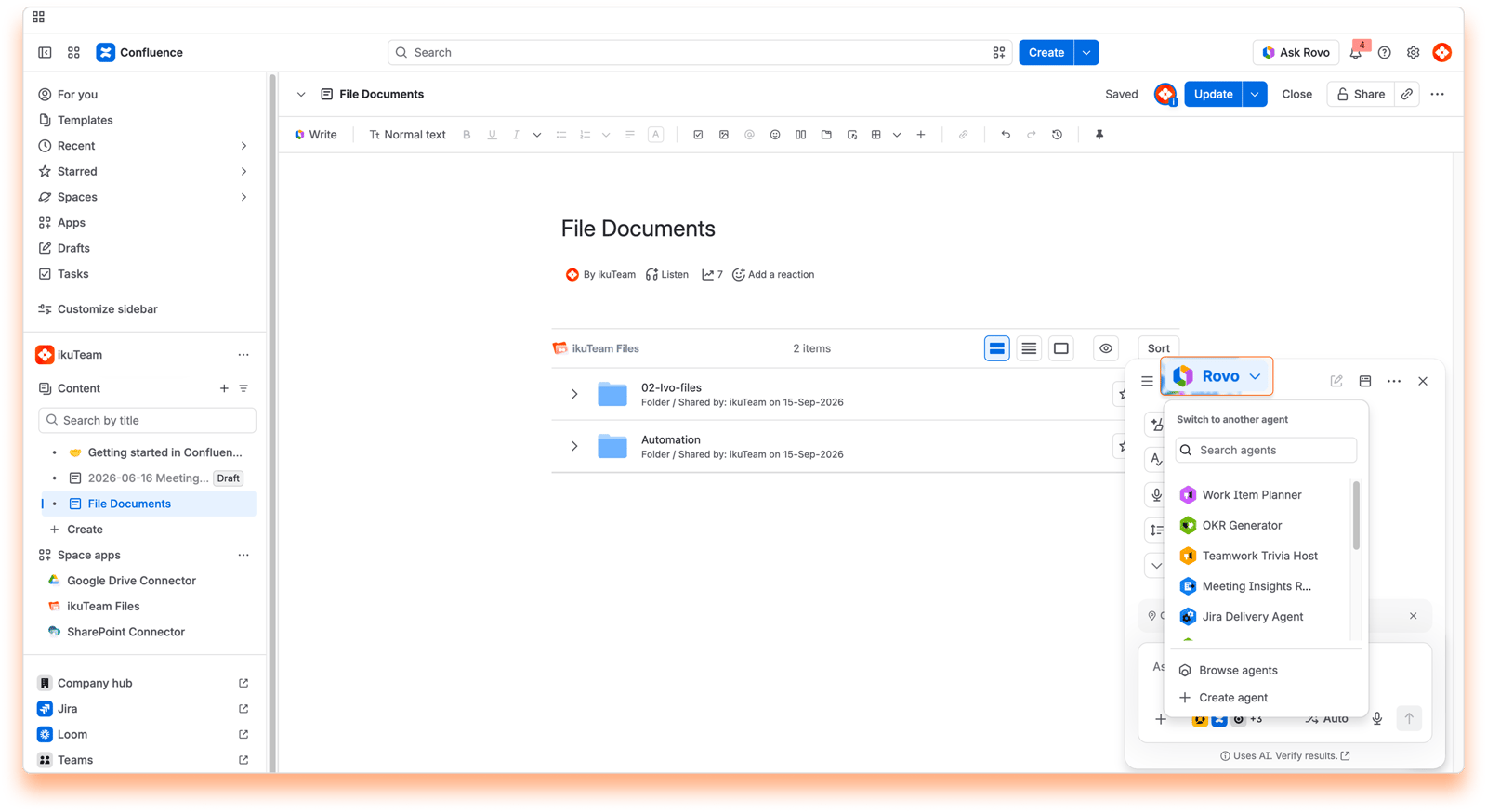
Select the Agent: Open the Rovo Chat and switch to the ikuTeam Files Agent to begin getting insights about the files added to your page.
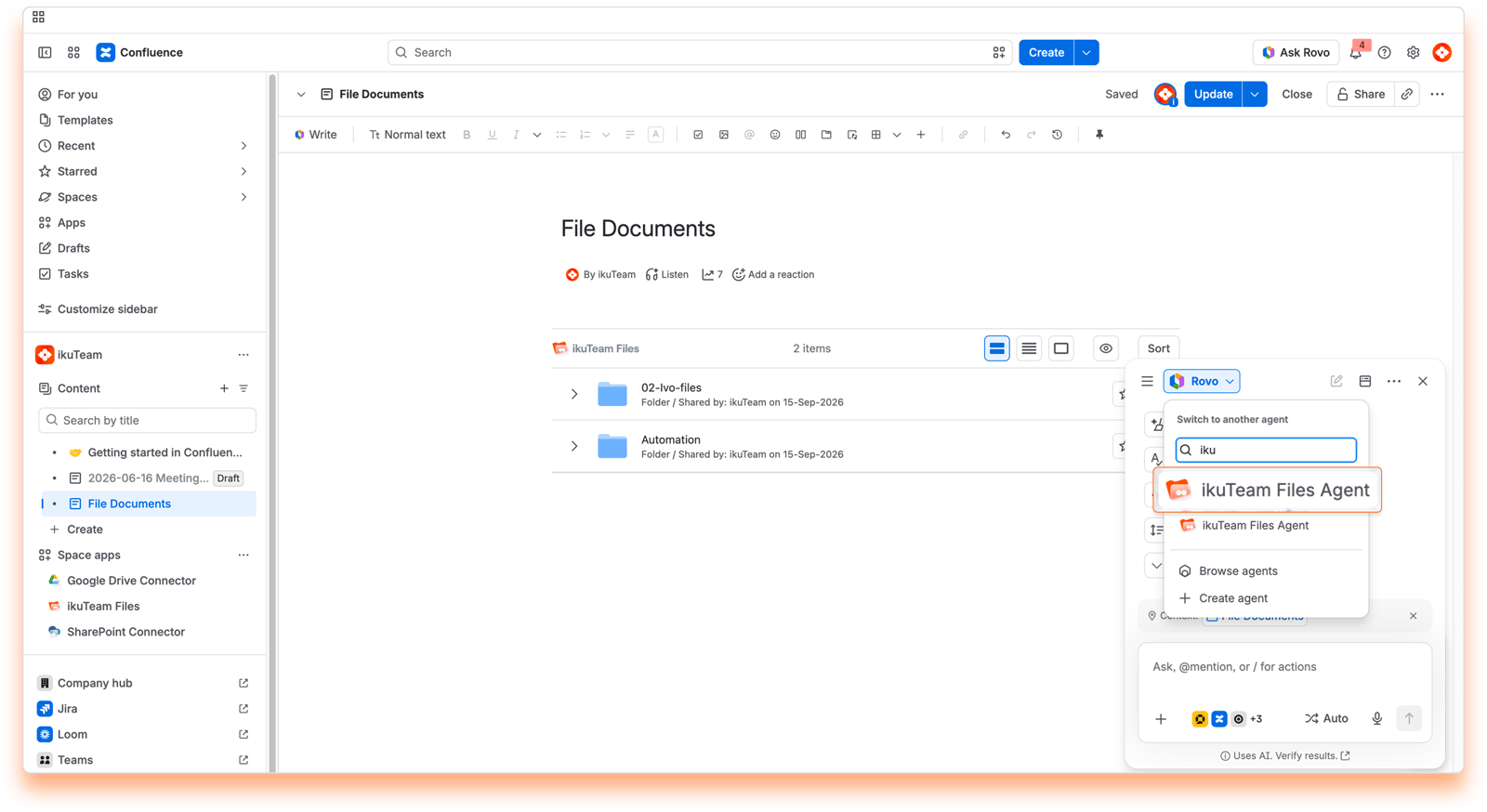
Ask about a page: Open the page whose files you want to ask about, then start typing, the same way you would message a teammate.
The agent works from the files and folders your team has already connected in Confluence, not from everything in your storage:
The files and folders attached to the page you are viewing with the ikuTeam Files macro.
The root folders connected to the space in the ikuTeam Files file manager, so a shared team library connected there can also give the agent context.
If a file or folder is already visible to Confluence from that page or space, the agent can see it too, whichever storage it lives in. If it is only in your personal storage, the agent cannot. To give the agent something to work with, attach the files to the page with the ikuTeam Files macro (see Attaching files and folders to pages) and publish the page.
If some of the folders connected to the space need authentication first, the agent can't search them yet. It lets you know with this message: "I may not have access to all your files. One or more folders require authentication before I can search them. Head to the app's File Manager to connect them." Connect those folders in the ikuTeam Files file manager, then ask again.
Very large files are read only in part. The agent reads up to the first 440,000 characters of a file. When a file is longer, it answers from that first part and tells you that the rest of the file wasn't read.
Instant AI Summaries: Generate concise highlights of long documents (PDF, Word, Excel, PowerPoint, and Google Docs, Sheets, and Slides) directly within a Confluence page.
Cross-Platform Intelligence: Ask questions about files stored in SharePoint, Google Drive, OneDrive, Box, Dropbox, and Egnyte without leaving Atlassian.
More context via the ikuTeam Files file manager: Access files inside the root folders connected to the Confluence space in the ikuTeam Files file manager to provide more context.
Find files by name: The agent finds a file by its name, or part of it, on the page or across the folders connected to your space. When you ask, it then reads the file's content to answer your question.
Secure Data Handling: The agent reads a file only when you ask, and we never store your files’ content.
You can interact with the agent using natural language. Try these examples:
"What are the files attached to this page?"
"Find the file named Budget in this space."
"Summarize the file ‘TestCases.xlsx’."
"What are the key takeaways from the PDF attached here?"
"Summarize the requirements doc attached here, and list anything that looks like a technical constraint."


